When the FTSE 100 reached 10,000 points for the first time on 2 January 2026, the milestone capped a strong 12 months for the index. Annual returns of 21.5% were more than double those delivered in 2024 (9.2%).
2025 marked the FTSE 100’s best year since 2009 – when markets were bouncing back from the global financial crisis – and the index’s seventh best year since 1985, when records began. The UK index also outperformed the S&P 500.
This strong performance came during a turbulent year that saw continued global conflict, increased political uncertainty, and no lack of short-term volatility.
So, what lessons can we learn from the FTSE 100’s record-breaking year about ignoring the noise and remaining focused, and the logic of investing during an all-time high?
Keep reading to find out.
White House foreign policy caused an April blip before a strong recovery
The imminent inauguration of President Trump meant that markets were braced for uncertainty from the outset in 2025.
Trump’s list of “day-one” promises included the cessation of hostilities in Ukraine, an “end” to inflation, and blanket tariffs on Canada and Mexico. The full extent of Trump’s protectionist “America First” agenda only became clear – and impacted markets significantly – in April, on so-called “Liberation Day”.
Investor reaction to the 90-plus tariffs announced on 2 April is clear from a look at the FTSE 100 for 2025. And yet, the UK index recovered.
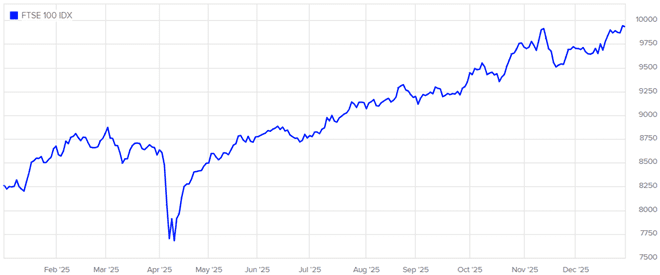
Source: London Stock Exchange
While the FTSE 100 is composed of UK-based firms, the majority are large multinational companies that derive their returns from global markets. While US tariffs caused initial concern, this uncertainty (among other factors) led to a boost for some stocks, such as mining, many of which are held in the FTSE.
2025 was also a strong year for the finance and insurance sectors (aided by higher interest rates) and for defence and aerospace – a result of continuing global conflict.
Other factors that helped lift the FTSE to its record-breaking 10,000 points include investor movement away from the US tech sector, in part due to concern about an AI bubble, and into cheaper, stable, and more defensive UK-based stocks. The potential for strong and steady dividend income in an uncertain equities market also played a part.
3 simple investing lessons the FTSE 100 taught us in 2025
1. Stay calm and ignore the noise
2025 was undoubtedly a turbulent year geopolitically, and for markets too. When significant events with global knock-on effects are reported almost every day, it can be easy to panic and anxiously revisit your investments.
It’s easy, too, to consider altering investments in line with your own views on likely political outcomes or predicted market movements.
Of course, markets are governed in part by investor sentiment, so political headlines can cause short-term ripples. But economic fundamentals, such as corporate earnings, interest rates, and factors affecting underlying asset classes, play a significant role too.
Adapting your strategy and trying to judge markets based on the “noise” of geopolitics and rolling news headlines could damage your progress towards your goals.
More advisable is to stay calm and trust in the historic (although not guaranteed) upward trend of the market.
2. Think long-term and don’t chase trends
You will have heard us say time and again that it’s time in the market, not timing the market, that counts.
The briefest glance at the FTSE 100 for 2025 will confirm the detrimental impact of cashing out at the beginning of April and not being invested as the shock of Liberation Day diminished and markets recovered.
Your investments are long term, exactly to ride out periods of short-term volatility, so staying calm, avoiding emotional knee-jerk reactions, and focusing on your ultimate goals is key.
Remember, too, that reaching your investment objective isn’t a race. It’s a carefully risk-managed journey aligned to your time frames, so chasing trends that don’t fit your risk profile is also generally to be avoided.
3. It’s ok to invest when markets are high
It can seem counterintuitive to invest during a market high. When markets peak, it’s reasonable to assume that the only way is down. And yet, in a stock market that trends upwards, all-time highs may occur more often than you think.
Schroders reported back in July 2025 that during the last 98 years, markets have been at an all-time high for 30% of the time. That’s 354 of more than 1,100 month-ends since 1926.
What’s more, average 12-month returns following an all-time high have been better over the last 100 years than at times when the market wasn’t at a high.
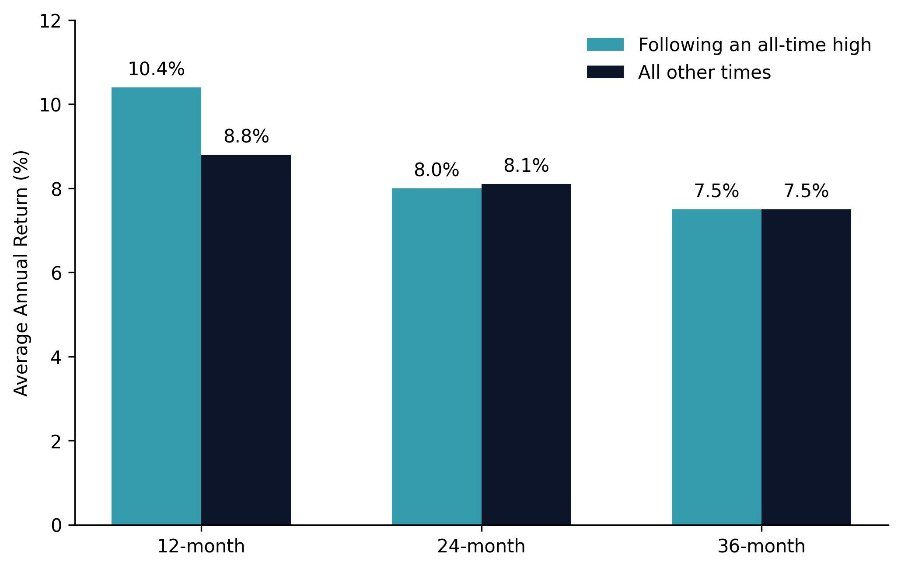
Source: Schroders (data)
This Schroders and Morningstar data suggests that investors shouldn’t be concerned about investing immediately after an all-time high, although, of course, past performance is no guarantee of future performance.
Get in touch
Your long-term investments are individual to you: your goals, time frames, and attitude to risk. Global markets fluctuate daily, and periods of short-term volatility are not only to be expected but are effectively built into your plan via its long-term horizon.
While it can be all too easy to panic when markets tumble or geopolitical uncertainty is rife, we’re on hand to offer reassurance and keep you on track, so be sure to speak to us if you have any questions.
Contact us online or call 020 7400 4700 today to help plan your loved ones’ financial future.
Please note
This article is for general information only and does not constitute advice. The information is aimed at individuals only.
The value of your investments (and any income from them) can go down as well as up, and you may not get back the full amount you invested. Past performance is not a reliable indicator of future performance. Investments should be considered over the longer term and should fit in with your overall attitude to risk and financial circumstances.