The Iran War has dominated news headlines in recent months. Alongside the unimaginable human cost, the conflict has impacted global trade, caused stock market fluctuations, and seen the price of oil rise sharply.
A month after the war began, oil prices, according to the US benchmark – West Texas Intermediate (WTI) – topped $100 per barrel. Despite a drop following the ceasefire announcement in early April, prices began to rise again and are expected to peak this summer.
With the situation constantly evolving, it isn’t clear exactly how high prices will rise. What is known is that geopolitical tension and escalation will impact markets, and rising oil prices will affect us all as the year continues.
Keep reading to find out how.
Oil prices are trending upward and may not fall consistently until the second half of 2026
The Strait of Hormuz lies between Iran and Oman and is critical for energy supplies globally – 20% of the world’s oil is transported through it. The strait has been shut since the end of February when the conflict started, and it has proved pivotal in ceasefire negotiations so far.
The initial two-week ceasefire reported by President Trump on 7 April confirmed that Iran would immediately reopen the strait (it had been open before the conflict but closed by Iran on 4 March). Since then, the US blockade of Iranian ports has led to retaliation and hundreds of ships – carrying as many as 23,000 crew members, according to the Guardian – are stranded in the Persian Gulf.
The Strait remains central to discussions that could end or escalate the crisis.
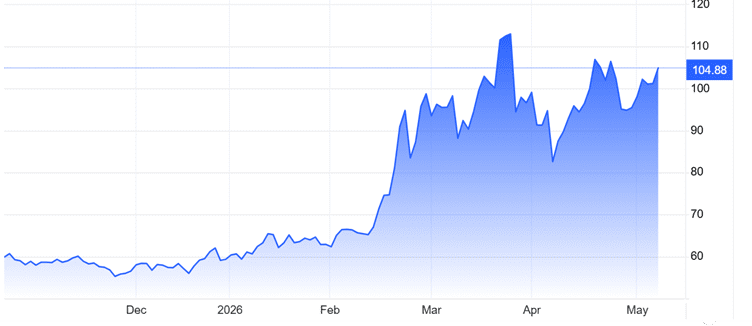
Crude oil (WTI) – 17 November 2025 to 15 May 2026:
Source: Trading Economics
As you can see from the above graph, oil prices had been stable in the six months leading up to the crisis. In fact, the last time prices exceeded $100 per barrel was back in 2022, a result of Russia’s invasion of Ukraine.
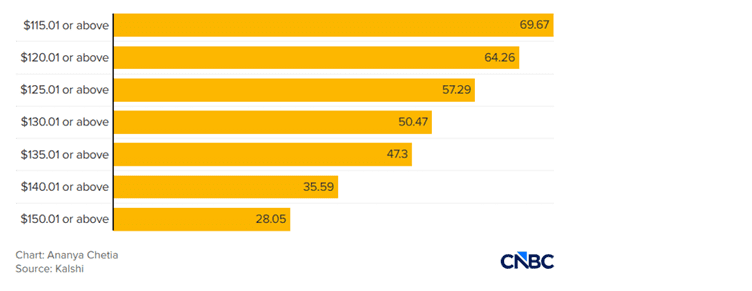
While prices peaked on 30 March at around $111 per barrel, expectations are that prices haven’t peaked yet. CNBC recently reported on the percentage chance of various oil price peaks before the end of 2026:
Source: CNBC
Most experts predict prices will peak toward the halfway point of the year, but they could be slow to fall, with knock-ons for global markets and UK interest and inflation rates.
Lengthy disruption in the Strait of Hormuz could lead to rising inflation and soaring energy costs
As a channel of global importance, a lengthy conflict and continued disruption in the Strait of Hormuz could lead to rising inflation.
The Consumer Prices Index peaked at 11.1% in the 12 months to October 2022 following the lifting of coronavirus restrictions and the resulting cost of living crisis. High inflation forced the Bank of England to increase its base rate, which in turn affects not only the interest rate on your savings, but also the cost of borrowing. High inflation resulting from the conflict could see mortgage rates rise again, alongside higher energy prices.
In the shorter term, the price of petrol has risen steeply as a result of rising oil prices, and we could see further increases as the year progresses.
Despite market volatility, your best option is usually to stay calm and focus on the long term
Global markets have reacted to the Iran War and rising oil prices, but it’s important to remember that short-term market volatility – whatever the cause – is built into your long-term financial plans.
A long-term time frame allows investments to recover after falls, so the most important thing to do is stay calm and not panic. Withdrawing funds hastily only cements a potential loss and also means your funds won’t be invested when the market recovers – as history suggests it will.
One of the most important ways we can help you at HFMC Wealth is by using our knowledge of markets and decades of experience to provide reassurance. Your portfolio is risk-managed, diversified, and aligned to your goals with short-term volatility built in.
That said, we understand that geopolitical uncertainty can be unsettling where your finances are concerned, which is why we’re always hand to help.
Get in touch
If you have any concerns about rising geopolitical unrest or about your wider wealth and long-term plans, get in touch with HFMC Wealth today. Contact us online or call 020 7400 4700 today to help plan your loved ones’ financial future.
Please note
This article is for general information only and does not constitute advice. The information is aimed at individuals only.
All information is correct at the time of writing and is subject to change in the future.
The value of your investments (and any income from them) can go down as well as up, and you may not get back the full amount you invested. Past performance is not a reliable indicator of future performance. Investments should be considered over the longer term and should fit in with your overall attitude to risk and financial circumstances.